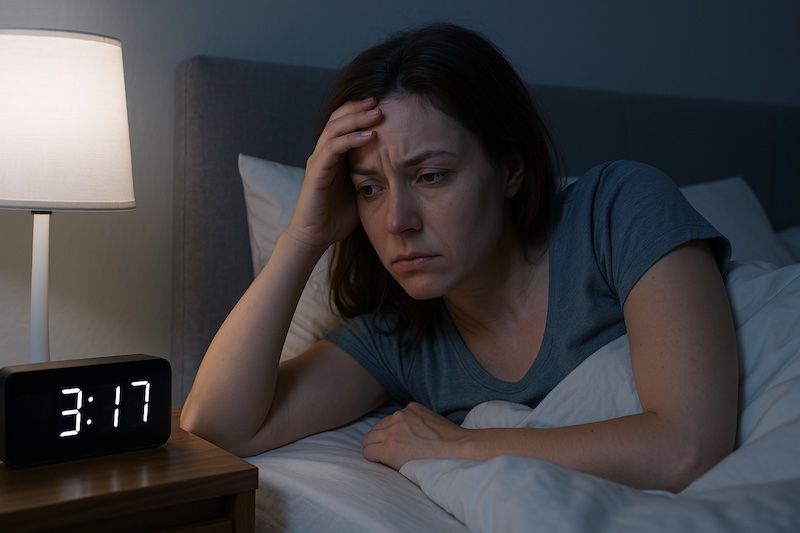
It has a specific, almost eerie consistency: not 1am, not 5am — 3am, night after night, eyes wide open in the dark. It’s common enough that it’s become something of a cultural shorthand for anxious insomnia. But there’s real physiology behind why this particular hour shows up so often, and it has less to do with anything mystical and more to do with a hormone most people only associate with stress.
The Physical Reason: Your Cortisol Clock
The body runs on a roughly 24-hour internal schedule called the circadian rhythm, orchestrated by a region of the brain called the suprachiasmatic nucleus — essentially your body’s master clock. Two hormones drive that rhythm in opposite directions: melatonin, which rises in the evening to bring on sleep, and cortisol, which is meant to be at its lowest point in the evening and early night, then begin climbing to wake you up.
Here’s the part that explains the timing so precisely: in a healthy sleep cycle, cortisol begins a slow, gentle rise starting around 2:00 to 3:00 AM, building gradually toward the sharp morning surge — known as the Cortisol Awakening Response — that gets you up and alert. In someone with a well-regulated stress response, this early rise is gentle enough to stay completely invisible under deep sleep.
But when the body’s stress-response system (called the HPA axis — hypothalamic-pituitary-adrenal axis) is overactive from chronic stress, anxiety, or an underlying health condition, that normally quiet rise can become a sharp spike instead of a slope — enough to actually pull you out of sleep.
Research also indicates that people with insomnia tend to show an earlier and steeper cortisol rise, particularly under chronic stress, which helps explain why some people are far more prone to 3am wake-ups than others.
Three More Physical Culprits
Cortisol isn’t the only mechanism at play. A few other well-documented physical processes cluster suspiciously around this same window:
- Blood sugar dips. Nocturnal hypoglycemia — a drop in blood sugar during sleep — typically occurs four to six hours after your last meal, which for most people lands squarely in the early morning hours. The brain interprets low fuel as a threat and responds by releasing cortisol and adrenaline to mobilize glucose, triggering a jolt of alertness in the process. People with insulin resistance are particularly prone to this pattern.
- Alcohol. A nightcap might help you fall asleep faster, but it tends to backfire hours later. Alcohol acts as a diuretic, increasing the need to urinate, while also causing rebound anxiety and a mid-sleep dip in blood sugar as it’s metabolized — a combination that reliably produces 3am wake-ups in people who drink close to bedtime.
- Undiagnosed sleep apnea. This one is easy to miss. Breathing pauses trigger brief arousal responses that spike heart rate, blood pressure, and cortisol — and because REM sleep (during which airway muscles relax the most) predominates in the early morning hours, apnea-related awakenings cluster between roughly 2 and 6am. Sleep apnea affects an estimated 39 million American adults, a large share of them undiagnosed.
The Psychological Reason: A Quiet Mind Finds the Loudest Thoughts
Here’s the piece that makes 3am wake-ups feel so specifically dread-inducing: even when the trigger is physical — a cortisol blip, a blood sugar dip — what keeps you awake afterward is often psychological. In the middle of the night, with no distractions, no to-do list, and no one to talk to, the mind tends to default to whatever it’s been avoiding during the day.
Anxiety, in particular, tends to surface most easily in these quiet, unoccupied moments — not because anxiety is somehow stronger at night, but because there’s nothing left to compete with it for your attention.
This creates a self-reinforcing loop that sleep researchers describe clearly: the physical spike (cortisol, blood sugar, alcohol withdrawal) wakes you up, and then anxious thinking about being awake — why am I up again, I have to be up in five hours — keeps cortisol elevated, which keeps you from drifting back down into sleep. The original physical trigger and the psychological reaction end up feeding each other.
What Actually Helps
- Don’t reach for your phone. Checking the time or scrolling exposes you to blue light, which suppresses melatonin production right when your body needs it most to fall back asleep.
- Address stress during the day, not just at night. Since an overactive HPA axis is a major driver of the pre-3am cortisol spike, daytime stress management — exercise, time outdoors, breathwork — has a more direct effect on nighttime wake-ups than most people expect.
- Watch your evening eating and drinking. Large meals close to bedtime can cause reflux, while alcohol and blood-sugar crashes are two of the most common, fixable triggers behind middle-of-the-night waking.
- Keep a consistent sleep and wake schedule, since circadian rhythm — and the cortisol curve tied to it — depends heavily on regularity to stay predictable.
- Talk to a doctor if it’s a persistent pattern, especially if it’s paired with loud snoring, gasping, or daytime fatigue, since those are red flags for sleep apnea, which is both common and highly treatable once diagnosed.
The Bottom Line
Waking at 3am isn’t random, and it isn’t a sign that something mysterious is happening to you. It sits at the intersection of a very real, well-documented hormonal rhythm — the natural pre-dawn rise of cortisol — and a psychological environment (silence, stillness, no distraction) that makes anxious thoughts easier to hear.
For most people, the fix isn’t complicated: it’s addressing the physical trigger (stress load, alcohol, blood sugar, sleep apnea) during the day, so there’s less for cortisol to spike into at 3am in the first place.
References
- Oura Ring — “Why Do I Always Wake Up at 3am?”
- Biology Insights — “Why Do I Wake Up at 3am? The Cortisol Connection”
- Sleep.com — “Common Reasons Why You Wake Up at 3 a.m.”
- Sleep Reset — “The Science Behind 3am Wake-Ups: What Your Body Is Trying to Tell You”
- Hirotsu, C., Tufik, S., and Andersen, M. L. “Interactions between sleep, stress, and metabolism: From physiological to pathological conditions.” Sleep Science, 2015.