The thyroid is a small, butterfly-shaped gland, but it regulates the metabolism of nearly every cell in your body — including the cells that build your nails.
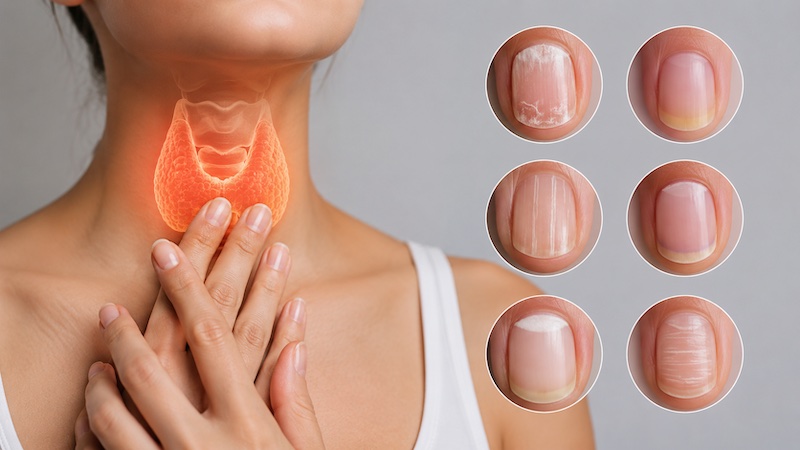
When thyroid hormone levels run too low or too high, nail growth, texture, and structure often change in specific, recognizable ways, sometimes before more obvious symptoms like fatigue or weight changes are even noticed.
A review of the medical literature on this topic, published in the dermatology journal Cutis, pulled together data from eight separate clinical studies to map out exactly how. Here’s what the numbers actually show.
1. Brittle, Fragile Nails
This is, by a wide margin, the most common nail change linked to thyroid disease. In one of the studies reviewed, fragility was reported in 70% of hypothyroid patients, making it the single most frequent nail finding associated with an underactive thyroid.
The mechanism is straightforward: thyroid hormone helps regulate keratin production, the protein that gives nails their strength, so when hormone levels drop, keratin production slows and nails become dry, thin, and prone to splitting or peeling.
2. Slow Nail Growth
Nails are essentially a running record of your metabolism, and when the thyroid slows down, that record shows it directly. The same body of research found slow nail growth in 48% of hypothyroid patients — a natural consequence of hypothyroidism putting the body’s cell division and turnover into a lower gear. Patients frequently describe waiting noticeably longer between manicures or trims than they used to.
3. Onycholysis (Nail Lifting from the Nail Bed)
Onycholysis is the medical term for when the nail plate separates or lifts away from the skin underneath it, usually starting at the tip. This finding showed up in 38% of hypothyroid patients in the reviewed research — and notably, it isn’t exclusive to an underactive thyroid.
The same review found onycholysis was also associated with hyperthyroidism, making it one of the few nail changes that can point toward thyroid dysfunction in either direction, rather than confirming which type you’re dealing with on its own.
4. Koilonychia, or “Spoon Nails”
This is where the nail becomes soft enough to curve upward at the edges, taking on a concave, spoon-like shape. While spoon nails are more commonly associated with iron deficiency, thyroid research tells a striking story here too: in a study specifically looking at patients with koilonychia, 68.8% were ultimately diagnosed with hyperthyroidism — a strong enough association that clinicians treat spoon-shaped nails as a genuine reason to check thyroid function, not just iron levels.
5. Nail Clubbing (Thyroid Acropachy)
Clubbing — where the fingertips widen and the nails curve down around them — is a rarer but more specific sign, most associated with Graves’ disease, an autoimmune form of hyperthyroidism. The research found clubbing affected 7.3% of Graves’ disease patients, appearing as part of a broader condition called thyroid acropachy.
It’s far from the most common thyroid nail sign, but when it does appear, it’s a fairly distinctive marker, and it typically develops later in the course of the disease — one study found associated skin changes appeared more than a year after the initial Graves’ diagnosis in most patients.
6. Thinning Nails
Beyond brittleness, hypothyroidism was also linked to genuine thinning of the nail plate in 40% of patients studied — nails that feel noticeably more delicate and less structurally sound than before, even apart from splitting or breaking.
This thinning, combined with slower growth, is part of why many patients describe their nails as feeling generally “weaker” during a period of undiagnosed or poorly controlled hypothyroidism.
Hypothyroid vs. Hyperthyroid Nails: Not the Same Pattern
It’s worth being precise here, since the two conditions don’t affect nails identically. Hypothyroidism — an underactive thyroid — tends to produce nails that are brittle, thickened, slow-growing, dry, and prone to lifting.
Hyperthyroidism — an overactive thyroid — more often produces nails that are soft, thin, and unusually flexible or “bendy,” sometimes tearing rather than snapping, alongside the spoon-shaped koilonychia pattern described above. Knowing which pattern you’re seeing can actually help a doctor narrow down which direction your thyroid may be off, even before bloodwork comes back.
What To Do If You Notice These Changes
Nail changes alone aren’t enough to diagnose a thyroid condition — plenty of things cause brittle or ridged nails, including simple nutrient deficiencies, frequent hand-washing, or aging. But thyroid-related nail changes rarely show up in isolation.
If you’re noticing any of the patterns above alongside other common thyroid symptoms — persistent fatigue, unexplained weight change, feeling unusually cold or hot, hair thinning, or changes in heart rate — it’s worth mentioning to a doctor and asking about a simple TSH blood test, which is the standard first step in evaluating thyroid function.
The encouraging news across all of this research: once thyroid hormone levels are brought back into a normal range, nail changes typically improve — it just takes time, since nails grow slowly and fully replace themselves over several months.
References
- Kaminska, A., et al. “Nail Changes Associated With Thyroid Disease.” Cutis, MDedge, 2022 (systematic review of 8 clinical studies).
- Liv Hospital — “7 Thyroid Problems Affecting Fingernails and Skin Explained”
- Blue Horizon Blood Tests — “Can Thyroid Issues Cause Nail Problems? Key Signs & Tips”
- The Root MD — “How Thyroid Issues Affect Nails? Nail Changes Explained”
- Florida Dermatology and Skin Cancer Centers — “Thyroid: How Your Skin, Hair, and Nails Tell a Story”