Most people only think about their nails when it’s time for a manicure. But dermatologists routinely check nails during physical exams for a good reason: nails are made of keratin, the same protein found in skin, and they can reflect what’s happening elsewhere in the body — sometimes weeks before other symptoms show up.
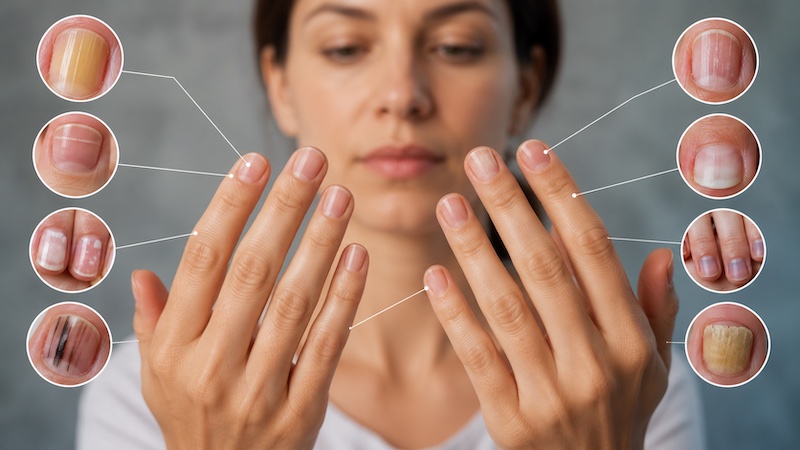
According to Mayo Clinic, healthy nails should be smooth, uniform in color, and free of ridges, pits, or spots. Here are 10 changes worth paying attention to.
1. Spoon Nails (Koilonychia)
If your nails are soft and curve upward at the edges — enough to hold a drop of water like a tiny bowl — that’s known as koilonychia, or spoon nails.
This shape change is most often linked to iron deficiency anemia. It can also point to hemochromatosis, a liver disorder in which the body absorbs too much iron. Less commonly, it’s associated with hypothyroidism or heart disease. The encouraging part: once the underlying deficiency or condition is treated, nail shape often returns to normal.
2. Pitted Nails
Small dents or pinprick-like depressions scattered across the nail surface are called nail pitting. This is one of the more common nail signs of psoriasis, and it can also show up with eczema or alopecia areata, an autoimmune condition that causes hair loss.
Nail pitting is worth mentioning to a dermatologist even if you don’t yet have a psoriasis diagnosis, since nail changes sometimes appear before the skin plaques do.
3. Clubbed Nails
“Clubbing” happens when the fingertips enlarge and the nails curve down around them, resembling an upside-down spoon. It usually develops gradually, over months or years, which makes it easy to miss.
Clubbing is associated with chronically low oxygen levels in the blood and is linked to lung disease, heart problems, liver cirrhosis, and inflammatory bowel disease. Because it tends to develop alongside other symptoms — like shortness of breath — nail clubbing is rarely the only sign, but it can be the detail that prompts someone to finally see a doctor.
4. Terry’s Nails
In this pattern, most of the nail turns an opaque white or pale color, with only a narrow band of pink or reddish-brown left at the very tip. Terry’s nails can simply be a normal part of aging, but they’ve also been associated with more serious conditions, including liver disease, congestive heart failure, and diabetes.
5. Beau’s Lines
These are horizontal grooves or ridges that run across the nail, rather than up and down. They form when nail growth is temporarily interrupted — often by a high fever, a serious infection, an injury, or extreme physical stress on the body.
Since the nail keeps growing afterward, Beau’s lines slowly move toward the fingertip and eventually grow out. On their own they’re not usually dangerous, but they’re a visible record that the body went through something significant.
6. Yellow Nails
Yellowing nails are frequently caused by a fungal infection, which can also make nails thicker and cause them to crumble at the edges. But persistent yellowing isn’t always fungal — it can also be linked to chronic bronchitis or other respiratory conditions, and in some cases to liver or kidney problems. If a suspected fungal infection doesn’t respond to over-the-counter treatment, it’s worth having it evaluated rather than assuming it’s cosmetic.
7. Bluish Nails
A blue or purplish tint to the nail bed usually signals that the blood isn’t carrying enough oxygen. This can happen with certain lung diseases, some heart conditions, or exposure to very cold temperatures. Bluish nails that appear suddenly, especially alongside shortness of breath or chest discomfort, warrant prompt medical attention rather than a wait-and-see approach.
8. White Nails or White Patches
Nails that turn mostly white, sometimes with the normal pink fading almost entirely, can be associated with liver conditions such as hepatitis.
Smaller white spots or streaks, on the other hand, are usually the result of minor trauma to the nail — a bump or a pinch — and simply grow out over time with no medical significance at all. The key difference is pattern: scattered small spots are typically harmless, while a uniform whitish cast across most of the nail deserves a conversation with a doctor.
9. Onycholysis (Nail Separation)
This is when the nail begins to lift or separate from the skin underneath it, often starting at the tip and moving toward the base. Causes range from fungal infections and psoriasis to thyroid disease, and even certain medications, including some retinoids and chemotherapy drugs. A separated nail is also more vulnerable to infection underneath, so keeping the area clean and dry while it’s evaluated matters.
10. A Dark Streak or Spot Under the Nail
This is the one dermatologists take most seriously. A new dark line or spot underneath the nail is sometimes mistaken for a simple bruise from an accidental injury.
But when there’s no clear history of trauma — or the mark doesn’t grow out and fade the way a bruise would — it needs prompt evaluation, because in rare cases it can be a sign of subungual melanoma, a form of skin cancer that develops under the nail. This type of melanoma is easy to miss precisely because it looks so much like an ordinary bruise, which is exactly why early professional evaluation matters.
When to See a Doctor
Not every nail change is a medical emergency — normal aging, minor injuries, and nail polish alone can all cause temporary changes. Mayo Clinic advises seeing a healthcare provider or dermatologist if you notice: a change in nail color that doesn’t have an obvious cause, changes in shape or thickness, thinning or thickening of the nail, separation of the nail from the skin, or swelling or pain around the nail.
Because nails grow slowly, tracking a change over several weeks — rather than reacting to a single day’s appearance — is usually the most useful way to decide whether it’s worth a medical visit.
References
- Mayo Clinic — Fingernails: Do’s and don’ts for healthy nails
- Mayo Clinic — 7 fingernail problems not to ignore
- Mayo Clinic — Nail ridges: Cause for concern?
- Mayo Clinic News Network — What Can Fingernails Reveal About Health?
- Mayo Clinic News Network — Mayo Clinic Minute: Fingernails are clues to your health
- American Academy of Dermatology Association — Nail Care