Most “diuretic salad” and “detox” recipes online rely on the same shaky claims: this ingredient “flushes toxins,” that one “melts fat overnight.” The truth is less dramatic but far more useful.
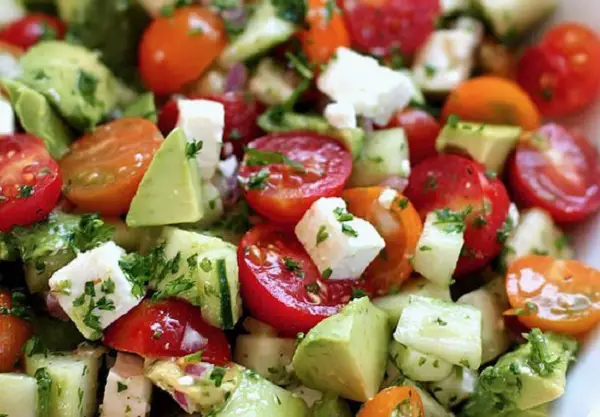
A salad built around cucumber, tomato, avocado, red onion, and parsley genuinely can help with bloating and weight management — just not through magic. It works through potassium balance, fiber, water content, and satiety, all of which have real research behind them.
Why This Combination Makes Nutritional Sense
It rebalances sodium and potassium — the real driver of “bloat”
Most of what people call bloating isn’t fat; it’s temporary water retention caused by an imbalance between sodium and potassium. When sodium intake is high — think processed foods, canned goods, restaurant meals — the body holds onto extra water to keep its internal chemistry balanced, which shows up as puffiness in the face, hands, and abdomen.
Potassium works in the opposite direction: it helps the kidneys clear excess sodium and fluid through urine, which is why a diet richer in potassium (and lighter in processed sodium) tends to reduce that puffy, swollen feeling. Tomatoes, cucumber, and avocado are all solid potassium sources, which is the actual mechanism behind “diuretic” vegetables — not some mysterious detox effect.
Cucumber and tomato add volume without adding many calories
Cucumbers are roughly 95% water, and tomatoes aren’t far behind. Nutrition researchers who study energy density — most notably Barbara Rolls’ “Volumetrics” research at Penn State — have repeatedly found that foods with high water and fiber content and low calorie density help people feel full on fewer calories, because the stomach responds to the volume of food as much as to its calorie content.
That’s a genuinely useful mechanism for anyone trying to eat less without feeling deprived, and it doesn’t require any pseudo-scientific “elimination” of foods.
Avocado does more than add creaminess — it’s one of the better-studied satiety foods
The original recipe credited avocado’s “healthy fats” with helping burn fat, which overstates the case — no food burns fat on its own. What the evidence does support is satiety. In a randomized crossover trial from Loma Linda University published in Nutrition Journal, overweight adults who added half a Hass avocado to a lunch meal reported 23% greater meal satisfaction and a 28% lower desire to eat over the following five hours, compared with an avocado-free meal.
Follow-up studies have linked this effect to avocado’s combination of monounsaturated fat and fiber, which triggers hormones like PYY and GLP-1 that signal fullness to the brain. Separate 12-week randomized controlled trials on daily avocado consumption have shown improvements in markers like small, dense LDL cholesterol oxidation, though effects on blood glucose and insulin resistance specifically have been more mixed across studies.
In short: avocado won’t burn fat, but it’s genuinely one of the more evidence-backed foods for feeling satisfied after a meal, which matters a great deal for weight management over time.
Red onion and parsley: real benefits, smaller evidence base
Red onion contains fructans, a type of prebiotic fiber that feeds beneficial gut bacteria — a genuine benefit for gut health in most people. One caution worth flagging: fructans are also a FODMAP, meaning that people with irritable bowel syndrome or small intestinal bacterial overgrowth (SIBO) may find that onion increases bloating rather than reducing it. If that’s you, this is one ingredient worth swapping out or reducing.
Parsley has a long folk history as a mild diuretic, but the clinical evidence in humans is thin — mostly small studies and traditional use rather than large randomized trials — so it’s fair to include it for flavor and its vitamin K and antioxidant content, without overstating its “detox” reputation.
Feta adds protein, which matters more than people think
Protein has a well-documented effect on satiety, generally stronger than either fat or carbohydrate per calorie, largely because it takes longer to digest and has a more pronounced effect on satiety hormones. A modest amount of feta is optional in this recipe, but adding it — or another lean protein like grilled chicken or chickpeas — is one of the simplest ways to make the salad more filling as a full meal rather than a side dish.
The Recipe
Serves 2 as a main dish, 4 as a side
Ingredients
- 1½ cups cherry tomatoes, halved
- 1 seedless cucumber, peeled and diced
- 1 ripe avocado, cubed
- ¼ cup crumbled feta cheese (optional, for added protein)
- 2 tablespoons finely chopped red onion
- 2 tablespoons chopped fresh parsley
- 2 tablespoons extra-virgin olive oil
- 1 tablespoon red wine vinegar
- Sea salt and black pepper, to taste
Instructions
- Combine the halved cherry tomatoes and diced cucumber in a large bowl.
- Gently fold in the cubed avocado and feta, if using.
- Add the chopped red onion and parsley.
- In a small separate bowl, whisk together the olive oil, red wine vinegar, salt, and pepper.
- Pour the dressing over the salad and toss gently — avocado and feta break down easily, so a light hand helps keep the texture intact.
- Serve immediately; this salad doesn’t hold well overnight, since the cucumber releases water and the avocado oxidizes.
What This Salad Can’t Do
To be direct about the limits: this salad will not “eliminate toxins,” and there’s no reliable evidence that any food does — the liver and kidneys already handle that job continuously, with or without a specific vegetable’s help. It also won’t cause meaningful fat loss on its own.
What it can do, based on the mechanisms above, is help with the temporary, water-based puffiness that many people describe as bloating, and support a lower-calorie, higher-fiber eating pattern that’s genuinely associated with weight management over time — but only as part of a broader diet, not as a stand-alone fix eaten occasionally.
Making It Work as Part of a Weight-Management Diet
- Watch the sodium elsewhere in your day. Potassium-rich foods help, but they can’t fully offset a diet that’s otherwise high in processed sodium.
- Eat it consistently, not as an occasional “reset.” The satiety and fiber benefits described above come from regular intake, not a single meal after a heavy weekend.
- Add a protein source if using it as a main meal, since the protein content of the base recipe (aside from optional feta) is fairly low for a standalone dish.
- If you have IBS or suspect SIBO, consider swapping the onion for a low-FODMAP alternative like the green tops of scallions, since fructans can worsen bloating in that specific group.
Used this way, the salad is a genuinely solid nutritional choice — just not for the reasons the “diuretic” framing usually suggests.
Sources
- Dr. Nutrition UAE, Why Do Low Potassium and High Sodium Cause a “Bloated Body” Appearance?: https://drnutrition.com/en-ae/blog/why-do-low-potassium-and-high-sodium-cause-a-bloated-body-appearance
- A. Vogel, Can potassium help with bloating?: https://www.avogel.co.uk/food/can-potassium-help-with-bloating/
- Wien, M., Haddad, E., Oda, K., Sabaté, J. (2013). A randomized 3×3 crossover study to evaluate the effect of Hass avocado intake on post-ingestive satiety, glucose and insulin levels, and subsequent energy intake in overweight adults. Nutrition Journal, 12:155: https://pubmed.ncbi.nlm.nih.gov/24279738/
- Wang, L. et al. The design and rationale of a multi-center randomized clinical trial comparing one avocado per day to usual diet: The Habitual Diet and Avocado Trial (HAT): https://www.sciencedirect.com/science/article/pii/S1551714421003013
- Zhu, L., Huang, Y., Edirisinghe, I., Park, E., Burton-Freeman, B. (2019). Using the Avocado to Test the Satiety Effects of a Fat-Fiber Combination in Place of Carbohydrate Energy in a Breakfast Meal in Overweight and Obese Men and Women: A Randomized Clinical Trial. Nutrients, 11(5):952: https://www.ncbi.nlm.nih.gov/pmc/articles/PMC6567160/
- The Journal of Nutrition, Avocado Consumption for 12 Weeks and Cardiometabolic Risk Factors: A Randomized Controlled Trial: https://jn.nutrition.org/article/S0022-3166(22)00699-X/fulltext
- Rolls, B.J., Penn State University, Laboratory for the Study of Human Ingestive Behavior — faculty profile and research on energy density and satiety: https://hhd.psu.edu/contact/barbara-rolls
- Monash University FODMAP research on onion/fructans and IBS symptom triggers: https://www.monashfodmap.com/